Conflict Resolution
Beyond the Drama
Drama. Do we love it or loathe it?
Regardless of how we feel, it persists. It pulls many of us in, often without conscious intention.
Why does this happen?
At its core, drama is usually less about solving problems and more about the need to be right. It can also be shaped by the conflict patterns we learn early in life. Our family environments influence how we respond to tension and the roles we instinctively adopt.
Some of us see ourselves as victims of circumstance. Others step into the rescuer role, the ever-ready white knight. And some become antagonists, calling the shots, assigning blame and rejecting any shades of grey.
What’s certain is this: drama thrives on intensity. It is a clash of perspectives with little room for middle ground.
When intensity hits, we triangulate.
When conflict escalates, a common response is triangulation.
Triangulation occurs when two people are in conflict and a third person is pulled in. That third person helps diffuse the tension by spreading the emotional load across three points instead of two. It feels instinctive and even logical. After all, a triangle is the most stable shape in physical structures. Think of the diagonal brace that keeps a gate strong and rigid.
But while triangles may offer short-term stability, they often create long-term dysfunction depending on who is involved.
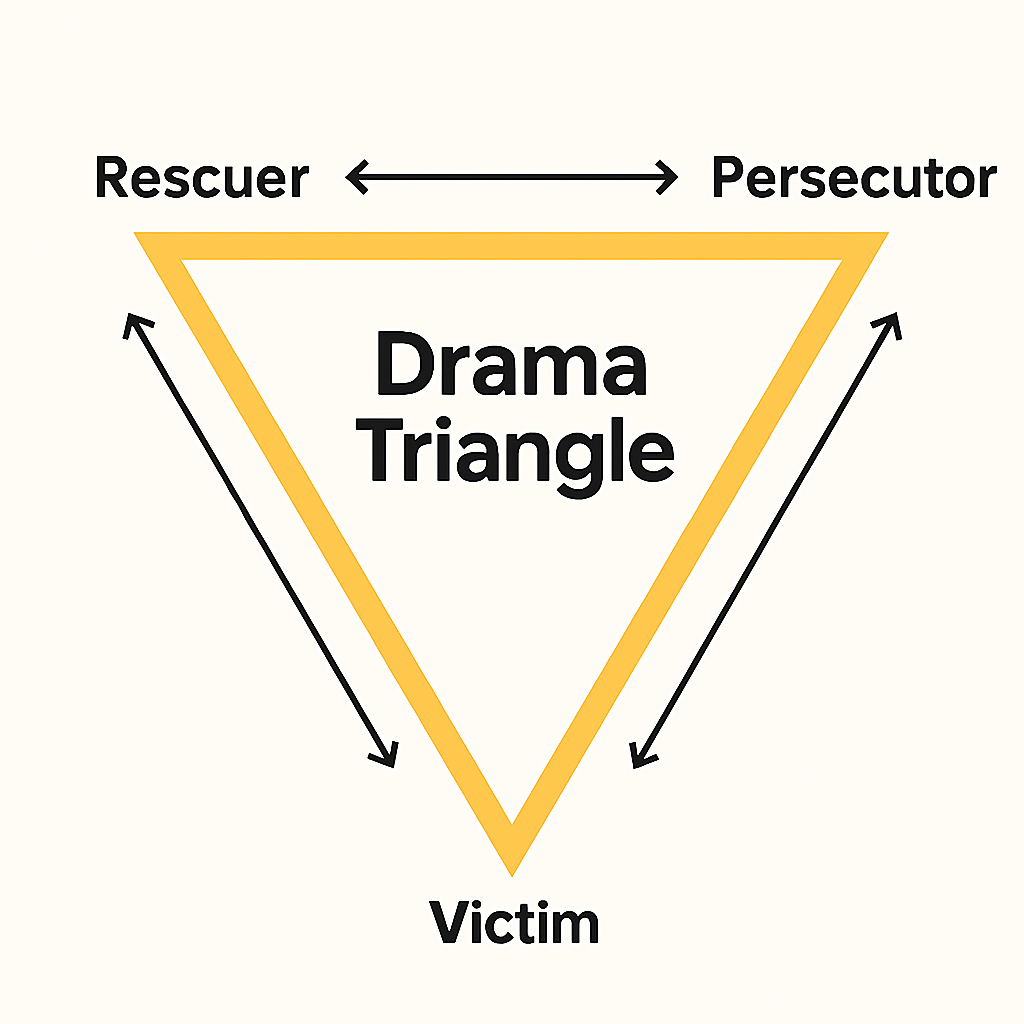
The problems usually fall into two categories:
- Drama perpetuation
Instead of resolving conflict, triangulation keeps it alive. The emotional energy simply circulates rather than settling. - Role entrapment
People unconsciously fall into familiar roles. The rescuer rushes in to fix things. The persecutor asserts control, often through blame. The victim avoids accountability by remaining passive.
How to Step Out of the Drama Triangle
The good news is that you can step out of the drama triangle. It takes awareness and intention but it is absolutely possible.
Three Takeouts to Escape the Drama Triangle
1. Know your payoff
Identify the unconscious reward you get from your usual role. Are you seeking validation as a victim? Control as a persecutor? Or self-worth through rescuing others? Honest self-reflection, whilst uncomfortable, is the first step toward real change.
2. Change the dialogue
Shift how you engage. Step out of the exaggerated role and move toward the centre of the triangle. Use collaborative, empathetic and solution-focused language. Aim for balance rather than extremes.
3. Break the absolutes
Drama feeds on black-and-white thinking: right vs wrong, fair vs unfair, good vs bad. Reality is rarely that simple. Most truths live somewhere in the middle. When we challenge absolute thinking, drama loses its grip and constructive resolution becomes possible.
The Bottom Line
Working constructively with others is always the goal. Workplaces in particular function far more smoothly when we stop feeding drama and start engaging with honesty, curiosity and balance.
It isn’t always easy, but it is always worth it.
Copyright 2026 Robin Elliott